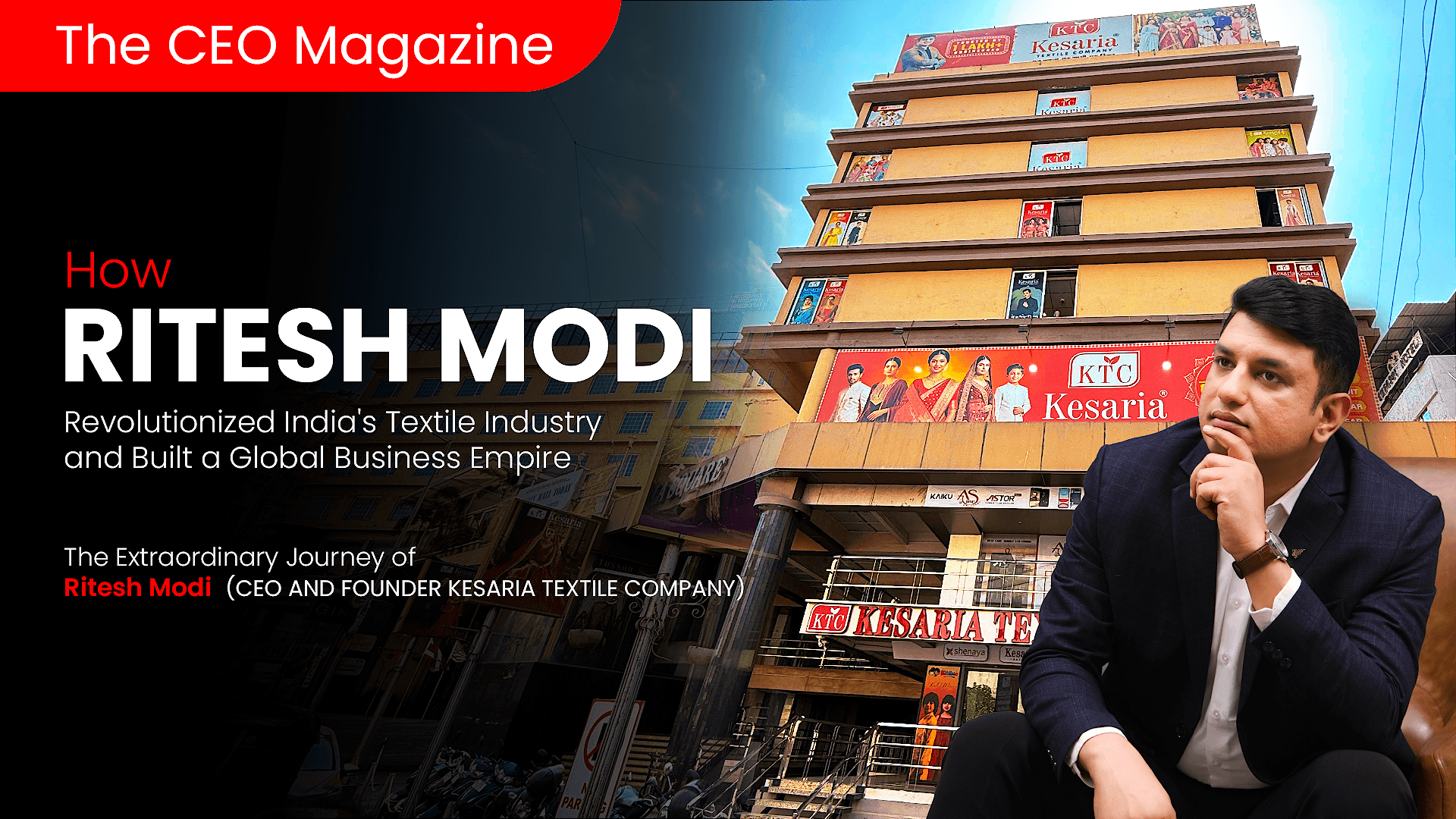
How Ritesh Modi Revolutionized India's Textile Industry and Built a Global Business Empire - The CEO Magnine
How Ritesh Modi Revolutionized India's Textile Industry and Built a Global Business Empire - The CEO Magnine. From a 500 Sq. Ft. Shop to a Rs100+ Crore Empire: The Extraordinary Journey of Ritesh Modi and Kesaria Textile Company. India's textile industry has witnessed countless success stories, but very few have transformed the entire business ecosystem the way Ritesh Modi, Founder and CEO of Kesaria Textile Company (KTC), has done. What started as a humble 500 sq. ft. textile outlet in Surat has today become a Rs100+ crore textile empire, serving more than 1 lakh retailers and wholesalers across India and 40+ countries worldwide.
Featured in The CEO Magazine, the inspiring journey of Ritesh Modi is not merely about financial growth. It is a story of vision, innovation, determination, and the courage to challenge traditional industry practices. By creating a direct factory-to-retailer model and empowering thousands of small business owners, he has rewritten the rules of textile commerce in India.
The Beginning of a Visionary Entrepreneur - Mr. Ritesh Modi
Every great business starts with a defining moment. For Ritesh Modi, that moment came while preparing for his Chartered Accountancy examinations.
Like many ambitious young Indians, he was pursuing a stable and prestigious career path. However, a life-changing conversation with his grandfather completely transformed his outlook toward success and entrepreneurship.
The simple yet powerful question—
"CA Banoge Ya CA Rakhoge?"
became the turning point of his life.
Instead of choosing a predictable professional career, Ritesh decided to enter the highly competitive textile industry. It was a bold decision because the industry was already dominated by established players, traditional supply chains, and deeply rooted business practices.
Yet, he believed that true growth comes from solving real-world problems.
Understanding India's Textile Market from the Ground Level
Before launching any business venture, Ritesh Modi spent years understanding the realities of India's textile ecosystem.
Between 2018 and 2020, he traveled extensively across India, visiting:
Textile manufacturing units
Wholesale markets
Rural retail shops
Boutique businesses
Weekly local markets
Distribution hubs
These journeys gave him first-hand exposure to the challenges faced by small retailers and boutique owners.
During his research, he discovered several major issues:
Multiple Middlemen
The traditional supply chain included numerous intermediaries:
Factory → Broker → Wholesaler → Agent → Retailer
Each layer increased product costs and reduced retailer profits.
Credit-Based Business Trap
Most retailers purchased stock on credit from wholesalers.
While this appeared convenient initially, it created long-term dependency and reduced business flexibility.
Limited Access to Factory Prices
Small retailers and boutique owners could never access genuine factory rates due to high minimum order requirements.
This limited their ability to compete effectively in local markets.
Recognizing these challenges, Ritesh realized that the industry required a complete structural transformation rather than another trading company.
Birth of Kesaria Textile Company
In 2021, amid economic uncertainty and post-pandemic market challenges, Kesaria Textile Company (KTC) was officially established in Surat, Gujarat.
Together with CFO Vatsal Jain, Ritesh Modi launched the company from a modest 500 square foot shop.
While the physical space was small, the vision behind the business was enormous.
The mission was simple:
"Direct Factory to Retail Shop Model"
The goal was to eliminate unnecessary intermediaries and provide retailers direct access to manufacturers.
This revolutionary approach created a transparent and profitable ecosystem for thousands of business owners.
Revolutionizing the Textile Supply Chain
The traditional textile business model had remained unchanged for decades.
Traditional Supply Chain
Factory → Broker → Wholesaler → Agent → Retailer
Kesaria Textile Company Model
Factory → Retail Shopkeeper
By removing unnecessary layers, KTC enabled retailers to purchase products at authentic factory prices.
This resulted in:
Higher profit margins
Faster inventory movement
Better product selection
Reduced financial burden
Improved business sustainability
For many retailers, profit margins increased from 10-15% to nearly 30-40%, creating a significant improvement in their business performance.
Empowering Small Retailers Across India
One of the biggest reasons behind KTC's success is its commitment to empowering small business owners.
Traditional manufacturers often require massive minimum order quantities (MOQs), making it difficult for smaller retailers to access wholesale rates.
Kesaria Textile Company solved this challenge by offering:
Flexible MOQ options
Thousands of product designs
Competitive factory pricing
Transparent business policies
Reliable product quality
Today, thousands of retailers and boutique owners rely on KTC as their preferred sourcing partner.
Building Trust Through Transparency
Unlike many traditional textile businesses, KTC adopted an advance-payment business model.
This strategy eliminated credit dependency and created a transparent transaction process.
The company focused on:
Honest pricing
Consistent quality
Reliable delivery
Long-term partnerships
As a result, KTC built one of the most trusted reputations in India's textile sector.
Corporate Social Responsibility at the Core
For Ritesh Modi, success is not measured solely by revenue.
He strongly believes that businesses must contribute positively to society.
As Kesaria Textile Company expanded rapidly between 2022 and 2025, social responsibility became a central pillar of its operations.
Supporting Indian Army Veterans
One of the most respected CSR initiatives undertaken by KTC focuses on retired Indian Army personnel.
Recognizing the challenges many veterans face while transitioning to civilian life, Ritesh Modi launched entrepreneurship support programs that provide:
Business mentorship
Retail management training
Inventory support
Business development guidance
This initiative has helped many veterans establish independent clothing businesses and achieve financial independence.
Contribution to Drug-Free Surat Campaign
KTC has actively participated in public awareness campaigns aimed at building a safer society.
The company became a prominent supporter of the Drug-Free Surat Movement, helping educate youth and communities about the dangers of substance abuse.
The initiative earned recognition from the Surat Police Department, which honored Ritesh Modi for his valuable contribution to public welfare.
Partnership with Akshaya Patra Foundation
Education and nutrition are key components of social development.
To support underprivileged children, Kesaria Textile Company partnered with the Akshaya Patra Foundation.
Through this collaboration, the company contributes toward providing nutritious meals to school-going children, helping improve educational participation and overall well-being.
Entering the Prestigious Rs100 Crore Club
The years 2024 and 2025 marked a major milestone in KTC's growth journey.
Through innovation, operational efficiency, digital transformation, and customer-focused strategies, the company achieved entry into the Rs100+ Crore Club.
This remarkable achievement was accomplished within just four years of operations.
The success established Kesaria Textile Company as one of India's fastest-growing textile businesses.
Strategic Brand Expansion
To serve multiple customer segments, Ritesh Modi diversified KTC's portfolio by launching specialized brands.
Menzaro
A premium men's fashion brand focused on Mens ethnic and casual wear collections.
Kikiboo
A high-quality kidswear brand offering fashionable clothing for children.
Kesaria Bazaar
A comprehensive franchise model designed to bring factory-direct clothing collections closer to retailers and consumers.
These brands helped KTC become a one-stop destination for family fashion.
National Recognition and Prestigious Awards
The outstanding growth of Kesaria Textile Company attracted attention from business organizations across India.
Ritesh Modi received several prestigious honors, including:
Excellence in Rapid Market Growth in Textiles Award
Presented by renowned Padma Shri awardees:
Mr. Mathur Savani
Sadguru Brahmeshanand Acharya Swami
India's Fastest Growing Textile Company Award
Recognizing KTC's exceptional growth trajectory.
BNI Junoon Excellence Award
Awarded for outstanding corporate performance and leadership.
These recognitions reinforced KTC's position as a leading force in India's textile industry.
Doriwala Square: Gujarat's Largest Factory Outlet
Perhaps the most visible symbol of KTC's growth is Doriwala Square in Surat.
What began as a 500 sq. ft. textile shop has evolved into a magnificent five-floor mega textile destination.
The facility offers:
10,000+ active designs
150+ clothing categories
Live product experience zones
Wholesale sourcing facilities
Global buyer support
Doriwala Square has become a landmark destination for textile buyers from across India and abroad.
Expanding Through the Kesaria Bazaar Franchise Network
Ritesh Modi's vision extends beyond manufacturing and wholesale.
Through the Kesaria Bazaar Franchise Model, the company has created a nationwide retail ecosystem.
Today, Kesaria Bazaar operates across numerous cities including:
Jaipur
Kanpur
Raipur
Ghaziabad
Jhunjhunu
Etawah
Karnal
Pusad
Nepal
Jabalpur
and many more.
With more than 40 franchise outlets, the network continues to expand rapidly.
Global Expansion and International Success
The success of Kesaria Textile Company is no longer limited to India.
In 2026, the company achieved a major milestone by launching Kesaria Bazaar Nepal in Kathmandu.
This marked the beginning of KTC's international franchise expansion strategy.
Today, the Kesaria Textile Company exports products to more than 40 countries, including:
United States
United Kingdom
United Arab Emirates
Nepal
Other global markets
This international presence has elevated Surat's textile craftsmanship to a worldwide audience.
Vision 2030: The Road to Rs500 Crore Valuation
Despite achieving remarkable success, Ritesh Modi believes the journey has only begun.
His Vision 2030 roadmap includes:
The story of Ritesh Modi and Kesaria Textile Company is a powerful example of how vision, innovation, and determination can transform an entire industry. From a humble 500 sq. ft. shop in Surat to a Rs100+ crore global textile empire, his journey demonstrates that success comes from solving real problems and creating value for others.
By empowering retailers, eliminating inefficiencies, embracing technology, supporting social causes, and expanding globally, Ritesh Modi has built far more than a textile company. He has created a movement that continues to generate opportunities, prosperity, and growth for thousands of entrepreneurs across India and around the world.
Kesaria Textile Company is not just building garments—it is weaving the future of global textile commerce.
Top 10 FAQs About Ritesh Modi and Kesaria Textile Company
1. Who is Ritesh Modi and why is he recognized in the textile industry?
Ritesh Modi is the Founder and CEO of Kesaria Textile Company (KTC), one of India's fastest-growing textile businesses. He is widely recognized for transforming a small 500 sq. ft. textile outlet in Surat into a Rs100+ crore business empire. Through innovation, direct factory-to-retailer supply chains, and retailer empowerment initiatives, he has become a respected leader in the Indian textile sector.
2. What inspired Ritesh Modi to enter the textile business?
While preparing for his Chartered Accountancy (CA) career, Ritesh Modi had a life-changing conversation with his grandfather, who asked him, "CA Banoge Ya CA Rakhoge?" This question inspired him to think beyond a conventional career path and pursue entrepreneurship. He chose to enter the textile industry with a vision to solve long-standing challenges faced by retailers and wholesalers.
3. What is the business model of Kesaria Textile Company?
Kesaria Textile Company operates on a Direct Factory-to-Retailer B2B model. Unlike traditional textile supply chains involving brokers, wholesalers, and agents, KTC directly connects manufacturers with retailers. This approach helps retailers purchase products at factory prices, improve profit margins, and eliminate unnecessary intermediaries.
4. How did Kesaria Textile Company grow from a small shop to a Rs100+ crore business?
KTC's growth was driven by strategic planning, extensive market research, transparent business practices, digital marketing, product diversification, and a strong retailer-focused approach. Starting from a 500 sq. ft. shop in Surat in 2021, the company expanded rapidly through wholesale distribution, franchise development, exports, and technology-driven operations, reaching the Rs100+ crore milestone within a few years.
5. What products does Kesaria Textile Company offer?
Kesaria Textile Company offers a wide range of ethnic and fashion wear products, including sarees, kurtis, salwar suits, lehengas, gowns, bridal wear, men's wear, kidswear, dupattas, and other apparel categories. The company provides access to thousands of trendy designs across multiple clothing segments for retailers and wholesalers.
6. What are the major brands operated by Kesaria Textile Company?
Kesaria Textile Company has successfully launched several brands to serve different market segments. These include Kesaria Bazaar, a clothing franchise model; Menzaro, specializing in men's fashion; and Kikiboo, a premium kidswear brand. Together, these brands help KTC cater to family fashion needs under one business ecosystem.
7. How does Kesaria Textile Company support small retailers and entrepreneurs?
KTC helps small retailers by offering flexible minimum order quantities (MOQs), factory-direct pricing, transparent transactions, and access to a large product portfolio. This enables retailers, boutique owners, and new entrepreneurs to start and grow their businesses without investing heavily in inventory or dealing with multiple suppliers.
8. What social initiatives are undertaken by Ritesh Modi and KTC?
Ritesh Modi actively promotes corporate social responsibility through various initiatives. These include supporting retired Indian Army veterans with entrepreneurship opportunities, partnering with the Akshaya Patra Foundation for child nutrition programs, organizing blood donation drives, and contributing to social awareness campaigns such as the Drug-Free Surat movement.
9. What awards and recognitions has Ritesh Modi received?
Ritesh Modi has received several prestigious awards for his contribution to the textile industry. These include the Excellence in Rapid Market Growth in Textiles Award, India's Fastest Growing Textile Company Award, POLICE PRIDE AWARDS, the BNI Junoon Excellence Award, Excellence in Textile Industry Leader of the Year 2026 Award. These honors recognize his leadership, innovation, and exceptional business growth.
10. What is the future vision of Kesaria Textile Company?
Kesaria Textile Company's Vision 2030 focuses on achieving a Rs500+ crore valuation, expanding the Kesaria Bazaar franchise network to more than 150 locations globally, strengthening exports, adopting sustainable manufacturing technologies, and empowering millions of retailers and entrepreneurs through innovative textile business solutions.
11. Why is Kesaria Textile Company considered one of India's fastest-growing textile brands?
Kesaria Textile Company is considered one of India's fastest-growing textile brands because of its unique direct-to-retailer business model, rapid franchise expansion, strong export presence, retailer-centric approach, diversified product portfolio, and ability to achieve Rs100+ crore business growth in a relatively short period while maintaining transparency and customer trust.